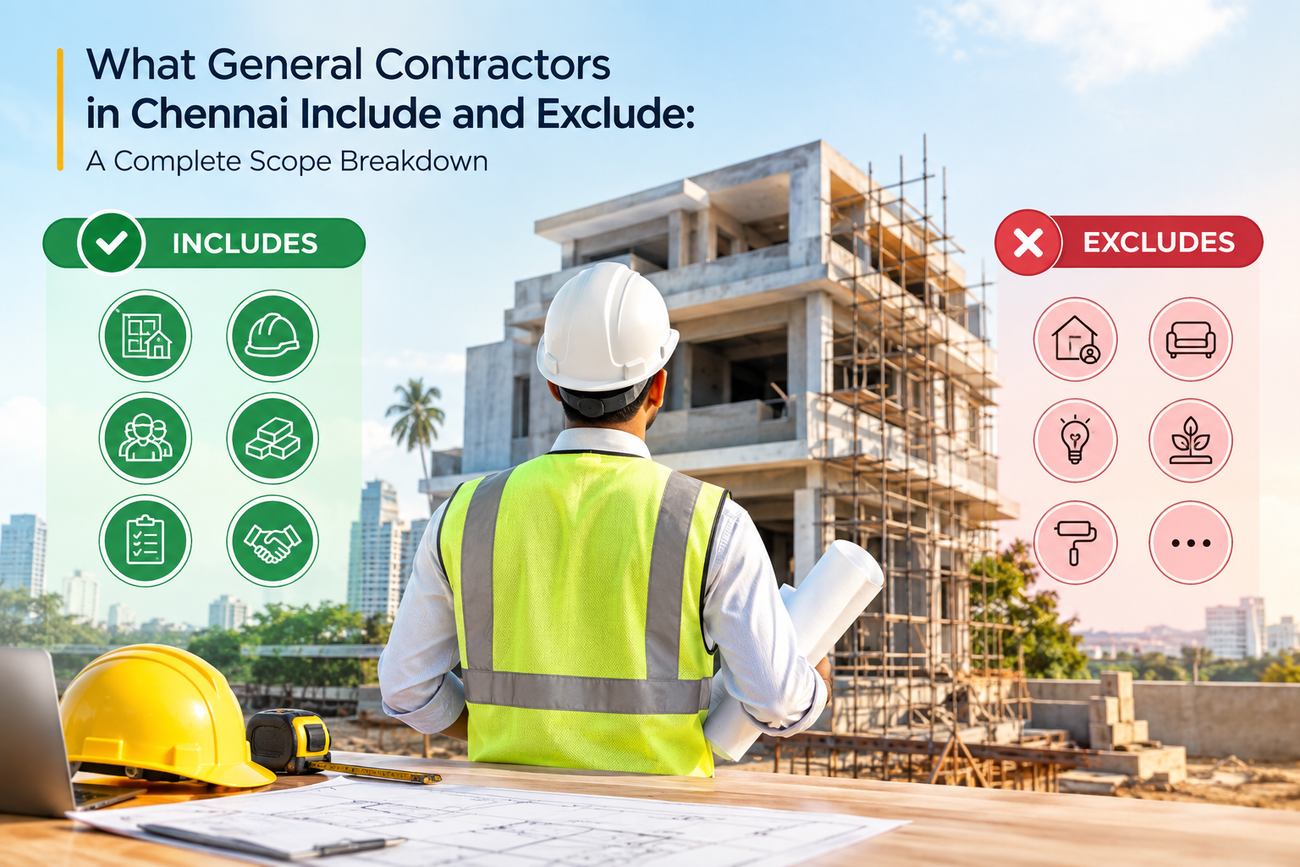
When planning a residential or commercial construction project in Chennai, understanding exactly what a general contractor includes and excludes is critical. Many property owners, NRIs, and landowners sign contracts only to discover mid-project that certain work is “not included” – leading to cost overruns, disputes, and delays.
This guide clarifies the boundaries of a full-service general contractor’s scope, helping you set realistic expectations before you commit.
The Role of a General Contractor in Chennai
A general contractor in Chennai acts as the primary point of accountability for your construction project. They’re responsible for managing day-to-day construction activities, coordinating subcontractors and labor, sourcing and delivering materials, ensuring work quality and timeline adherence, securing permits and plan approvals, and managing payment milestones and project documentation.
However, scope varies significantly between contractors, between project types, and between contractual agreements. What one contractor includes, another may exclude. Understanding these boundaries upfront protects your budget and timeline.
What a Full-Service General Contractor Typically Includes
1. Site Preparation and Survey
A full-service general contractor in Chennai typically begins with a site survey – a critical but often overlooked phase. During a site survey, your contractor will conduct:
- Soil testing and analysis (to determine foundation depth and RCC requirements)
- Dimensional verification of the plot against approved plans
- Assessment of ground slope, water table, and existing structures
- Documentation of site access and utilities (water, electricity, drainage)
Why it matters: Soil quality directly affects RCC quantity, foundation depth, and project cost. A contractor who skips this creates risk. In Chennai’s coastal climate, understanding soil profiles is essential – the city’s black cotton and expansive clay require specific foundation approaches. Reference the Bureau of Indian Standards (BIS) soil testing guidelines for standard requirements.
2. Structural Work (RCC and Masonry)
This is the core of what a general contractor delivers:
- RCC (Reinforced Cement Concrete) work: columns, beams, slabs, and structural frame
- Masonry: brick, block, or stone walls
- Shuttering and de-shuttering (formwork installation and removal)
- Concrete curing (proper water management for strength)
A full-service contractor sources cement, steel, sand, and aggregates, manages labor, and ensures structural quality per building codes. Chennai’s cyclone exposure means structural design must meet wind load requirements that inland cities do not face.
3. Electrical Installation (First Fix and Second Fix)
General contractors typically include:
- First fix: conduits, cable trays, and wiring during structural work
- Second fix: switch boxes, outlets, light fittings, and circuit installation (often after plumbing and waterproofing)
- Earthing and lightning protection installation
- Temporary site electrical supply during construction
Note: Some contractors exclude panel installation, VFD work, or specialized electrical systems – verify your contract.
4. Plumbing Installation (First Fix and Second Fix)
A comprehensive scope includes:
- First fix: underground drainage lines and water supply pipes (before RCC)
- Second fix: connection to wall-mounted fixtures (taps, showers, WC)
- Septic tank or sewer connection
- Internal drainage and roof drainage systems
- Proper slope and gradient management for drainage
5. Waterproofing and Weatherproofing
This is critical in Chennai’s humid, coastal climate. Your contractor should manage:
- External waterproofing on basements and foundations
- Terrace waterproofing (membrane or cement-based)
- Window sill waterproofing and caulking
- Roof edge detailing and drainage
Why it matters: Poor waterproofing is a leading cause of structural damage in Chennai. A full-service contractor ensures proper application. If waterproofing is critical to your project, ask your contractor about their warranty coverage and get it in writing.
6. Finishing Work
This phase includes:
- Plastering (cement mortar on walls)
- Internal wall finishes (paint, tiles, cladding)
- Floor finishes (tiles, marble, polished concrete)
- Door and window frame installation
- Stairs and railings (structural steel or reinforced concrete)
- Ceiling systems (false ceiling, plaster, or exposed)
For premium finishes beyond standard painting and tiling, you may want to explore additional options. Many homeowners work with interior design specialists for custom finishes after the structural work is complete.
7. Plan Approval and Basic Documentation
Many general contractors in Chennai handle or coordinate plan approval processes:
- Building plan approval with municipal authorities per Greater Chennai Corporation guidelines
- Completion certificate documentation
- Layout approval and sanctioned drawings
- Occupancy clearance processes
Note: This varies by contractor and municipality. Verify coverage in your contract.
What General Contractors Typically Exclude
Understanding exclusions is equally important. Common items outside general contractor scope include:
1. Design and Architectural Work
- Architectural design, renderings, and detailed drawings
- Structural calculations and engineering designs
- Interior design and space planning
- Interior styling and decoration
Why: These require specialized design professionals and are typically sourced separately before contractor engagement. If you need design support, this should be arranged before contractor selection.
2. Specialized Interior Finishes
- Premium wall finishes (wallpaper, 3D panels, acoustic finishes)
- High-end flooring (wood, polished concrete, specialty tiles)
- Bespoke cabinetry and built-in furniture
- Premium paint finishes (textured, metallic, designer brands)
Note: Some contractors offer these as add-on packages, but they’re not part of standard general contractor scope.
3. HVAC, Ventilation, and Climate Control
- Central air-conditioning systems
- Ducting and air handling units
- Smart ventilation systems
- Specialized cooling or heating
Why: HVAC requires specialized mechanical engineering and is typically subcontracted to HVAC specialists.
4. Fire Safety and Advanced Electrical
- Fire suppression systems
- Emergency lighting and signage
- Advanced switchgear or distribution boards
- Solar installation or battery backup systems
Why: These require certified specialists and are often subject to building regulations requiring third-party validation.
5. External Landscaping and Site Development
- Landscaping and garden design
- Compound walls and gates beyond basic structure
- External paving or driveway finishing
- Outdoor amenities (pools, water features, sports courts)
Note: Some contractors offer landscaping as a separate package.
6. Furnishings and Appliances
- Fitted kitchen and wardrobes (unless explicitly included)
- Sanitary ware, fittings, and fixtures (unless specified)
- Electrical appliances and light fittings (unless specified in contract)
- Window blinds and soft furnishings
Why: These are typically sourced and installed separately, giving owners flexibility in quality and brand choice.
7. Performance Guarantees Beyond Standard Warranty
- Lifetime waterproofing guarantees (most contractors offer 1–5 years)
- Structural condition insurance
- Quality bonds or performance guarantees beyond building code standards
General Contractor vs. Turnkey Construction: A Critical Distinction
A critical distinction emerges when comparing a general contractor to a turnkey construction company. If you’re exploring turnkey construction options, understand how they differ from general contractors:
General Contractor Model
- Manages structural work, basic MEP (mechanical, electrical, plumbing), and primary finishes
- Owner or project manager coordinates materials, approvals, and specialized work
- Greater flexibility but requires active owner involvement
- Typically lower cost for core structural work
Turnkey Construction Model
- Includes structural work, MEP, finishes, and often design consultation
- Contractor provides end-to-end accountability
- Less owner involvement, but higher overall cost
- Single point of responsibility for all delays and quality issues
For users searching “General Contractors in Chennai,” this distinction is essential – turnkey companies are not general contractors in the traditional sense. Each model has advantages depending on your involvement preference and budget.
Understanding Contract Terms and Payment Milestones
A full-service general contractor’s scope should clarify payment structure and deliverables at each stage:
Site Preparation & RCC Frame (40–50% of cost) Foundation completion, columns, beams, and slabs delivered with quality testing and inspection.
MEP & Waterproofing (25–30% of cost) Electrical first and second fix, plumbing first and second fix, and complete waterproofing application.
Finishing Work (15–20% of cost) Plastering, flooring, painting, door frames, and ceiling installation.
Project Completion & Handover (5–10% of cost) Final inspections, documentation, snag list closure, and occupancy certificate processing.
Why it matters: Payment tied to milestone completion protects both parties. Ensure each milestone has clear deliverables. Get a detailed construction estimate from your contractor before signing-this protects you from mid-project cost escalations.
Quality Checks and Warranty Scope
A reputable general contractor in Chennai includes:
- Third-party quality inspections at structural phases (foundation, RCC completion)
- Material testing (cement, steel, concrete strength)
- Workmanship warranty (typically 1–5 years for structural defects)
- Waterproofing warranty (typically 1–3 years)
- Standard warranty exclusions: damage from external factors, poor maintenance, unauthorized alterations
For more on what to expect during construction, read our guide on construction quality checks and inspection protocols. Note: Warranty scope and duration vary significantly by contractor. Always request written warranty terms.
How to Clarify Scope Before Signing
1. Request a Detailed Scope Document
Ask your contractor for a comprehensive list of what is included in the quoted price, what is excluded and available as add-ons, material specifications (cement grade, steel quality, etc.), timeline for each phase, and quality standards and inspection protocols.
2. Compare Scope Across Contractors
Don’t compare price alone – compare what each contractor includes. A lower-cost contractor may exclude critical items like waterproofing or electrical second fix, shifting costs to you later.
3. Get Clarification in Writing
Verbal agreements are sources of disputes. Ensure every inclusion and exclusion is documented in the signed contract.
4. Define Material Specifications
Specify cement grade (43 OPC, 53 OPC, or PPC per Indian Standards), steel quality (TMT, brand), brick/block type, paint brands and finishes, and electrical and plumbing brands.
5. Verify Plan Approval Responsibility
Clarify whether your general contractor handles architectural drawings, structural calculations, submissions to municipality, approval follow-up, and occupancy certificate processing. If plan approval is critical, ask about their timeline and experience with Chennai’s plan approval process.
Common Scope Disputes and How to Avoid Them
Dispute 1: “Waterproofing Was Not Quoted”
Prevention: Ensure waterproofing (terrace, external walls, basement if applicable) is explicitly included in the contract. Get the waterproofing method and warranty in writing. This is especially important in Chennai’s humid climate.
Dispute 2: “Electrical/Plumbing Work Stopped Halfway”
Prevention: Define first fix and second fix scope clearly. Specify switchboard installation, earthing, and fixture brands in advance.
Dispute 3: “Interior Finishes Are Extra”
Prevention: List every finish included: paint type, tile brands, flooring type. If the price quote doesn’t include finishes, it’s a structural contract only – cost and timeline will differ significantly from a semi-finished scope.
Dispute 4: “Timeline Extensions Due to ‘Unforeseen Issues'”
Prevention: Include a site condition survey in your pre-contract phase. Soil testing and site assessment reduce surprises. Get timeline buffers in writing.
Frequently Asked Questions
Q: What is the difference between a general contractor and a civil engineer in Chennai?
A general contractor manages the full execution of a project – labor, materials, coordination, timeline. A civil engineer designs the structure and supervises quality. Both are typically needed: engineer for design and inspection, contractor for execution.
Q: Does a general contractor in Chennai include plan approval?
Not always. Some contractors include it; others don’t. Clarify this upfront. Plan approval timelines can extend 2–4 months and directly impact project start dates. Confirm who bears responsibility and cost. If plan approval is complex, explore Dwellvise’s plan approval services.
Q: Can a general contractor provide a fixed-price quotation?
Yes, but only if scope is fully defined. A fixed-price quote requires detailed specifications, site survey, and clear material standards. Avoid fixed-price quotes based on per-square-foot estimates without site conditions and specification review.
Q: What is included in general contractor warranty in Chennai?
Typically:
- Structural defects: 1–3 years
- Waterproofing: 1–2 years (varies by method)
- Workmanship: 1–5 years (varies by contractor reputation)
Verify warranty duration and exclusions in your contract.
Q: How do I handle construction disputes with my general contractor?
- Document everything: photos, emails, revised plans, communication records
- Follow the contract timeline and payment process: deviations weaken your position
- Escalate in writing: formal email or letter (not verbal disputes)
- Involve a mediator or civil engineer: third-party inspection clarifies disputes
- Consider dispute resolution clauses in the contract upfront (arbitration, mediation, legal recourse)
Q: Can a general contractor work on residential AND commercial projects?
Yes. The core skills and scope are similar. However, commercial projects often involve more complex regulatory approvals (fire safety, occupancy limits), larger budgets and extended timelines, and specialized MEP systems (HVAC, fire suppression).
Verify your contractor’s experience in your specific project type.
Q: Should I hire a general contractor or a turnkey construction company?
Choose a General Contractor if:
- You want cost control
- You’re comfortable coordinating design, approvals, and specialized work
- You prefer flexibility in material selection
- You have an active project manager or engineer overseeing the work
Choose a Turnkey Company if:
- You want single-point accountability
- You prefer end-to-end coordination
- Timeline certainty is critical
- You’re willing to pay a premium for reduced involvement
If you’re leaning toward turnkey, Dwellvise offers complete turnkey construction services from design through final handover.
Q: What makes a general contractor reliable in Chennai?
- Track record: completed projects with verifiable client references
- Clear documentation: written contracts, detailed scope, transparent pricing
- Transparency on timelines: realistic schedules with documented buffers
- Third-party oversight: willingness to allow independent inspections
- Responsive communication: prompt replies to queries and change requests
Conclusion: Protect Your Investment Through Clear Scope Definition
When searching for general contractors in Chennai, remember: the cheapest quote often excludes critical work. A full-service general contractor should clearly define what is included, what is excluded, what is optional, and what is the contractor’s responsibility versus the owner’s.
Before signing, invest time in:
- Getting a detailed scope document
- Comparing contractor packages apples-to-apples
- Verifying material specifications in writing
- Clarifying warranty and quality standards
- Understanding payment milestones and conditions
A well-defined contract prevents disputes, protects your budget, and ensures your project is delivered on time and to quality.
Whether you’re exploring residential construction options, considering a home renovation, or planning a complete build, understanding general contractor scope is the foundation of a successful project.
Ready to Clarify Your Project Scope?
Planning a residential or commercial construction project in Chennai? A professional site consultation and detailed scope document are the first steps to a successful build. Dwellvise Developers can review your plot, project requirements, and construction scope to help you set realistic timelines and budgets before you commit to a contractor.
Request a Complimentary Site Consultation and written scope estimate to understand your construction requirements clearly.
