
If you’re searching for the best construction company in Chennai, you’ve probably already noticed the problem: dozens of builders claim to be “the best,” but very few explain how to actually judge one. Building a home is one of the biggest financial and emotional decisions most people make. In a city like Chennai – with its mix of coastal soil conditions, dense zoning rules, and a fast-growing number of construction companies advertising online – picking the right builder is harder than it looks. This guide is written to help you evaluate any construction company objectively, understand what actually drives cost and quality, and avoid the mistakes that cause most residential projects to go over budget or over schedule.
We are not going to hand you a ranked “Top 10” list – most such lists online are paid placements dressed up as recommendations. Instead, this guide gives you the exact framework a construction professional would use to identify the best construction company in Chennai for your specific project, so you can apply it to any builder you are considering.
1. Why Choosing the Right Construction Company Matters
A house is not a one-time purchase you can return if it’s wrong. Structural decisions made in the first three months of construction – foundation depth, steel grade, waterproofing method – determine how the building performs for the next 30–50 years. Choosing a builder based only on the lowest quote or the most attractive brochure is the single most common reason homeowners in Chennai end up with cost overruns, delayed handovers, or repair work within the first five years. This is exactly why identifying the best construction company in Chennai matters more than comparing prices alone.
The right construction company protects you in three ways:
- Structural safety – proper soil testing, correct steel-to-concrete ratios, and adherence to BIS codes.
- Legal safety – approvals from the Greater Chennai Corporation (GCC) or CMDA/DTCP so the building is never at risk of demolition or penalty.
- Financial safety – a fixed, transparent costing structure so the final bill doesn’t balloon 30-40% beyond the estimate.
Show Image Soil testing determines the right foundation type – a step the best construction company in Chennai will never skip.
2. Types of Construction Companies in Chennai
Before comparing companies, it helps to understand what kind of service you’re actually buying. In Chennai, “construction company” can mean very different things:
- Turnkey construction companies – handle everything from design and approvals to material procurement, labour, and finishing. You get a fixed price and a single point of accountability.
- Contract construction companies – provide labour and supervision, but you (or your architect) may source some materials separately.
- Labour contractors – provide only manpower; you or a separate contractor manage materials, design, and supervision.
- Design-and-build firms – start from architectural design and manage construction, often for higher-end villas or duplexes.
Most homeowners building an independent house today prefer turnkey or design-and-build models because they reduce coordination effort, even though the per-sq-ft cost is usually somewhat higher than managing labour contracts yourself. Explore our Turnkey Construction Services to see how this model works in practice.
3. Key Factors to Evaluate Before Hiring a Builder
These are the same factors a construction professional checks before recommending any builder – use them to test whether a company is really the best construction company in Chennai for your project, or just good at marketing.
Legal Approvals & Compliance
Confirm the company only builds on plans approved by the relevant authority – Greater Chennai Corporation for city limits, or CMDA/DTCP for areas under its planning jurisdiction. Ask to see a sample approved plan from a past project (with the client’s permission) rather than taking their word for it. Read more on our Building Plan Approval Guide (create this page if it doesn’t exist yet).
Experience & Portfolio
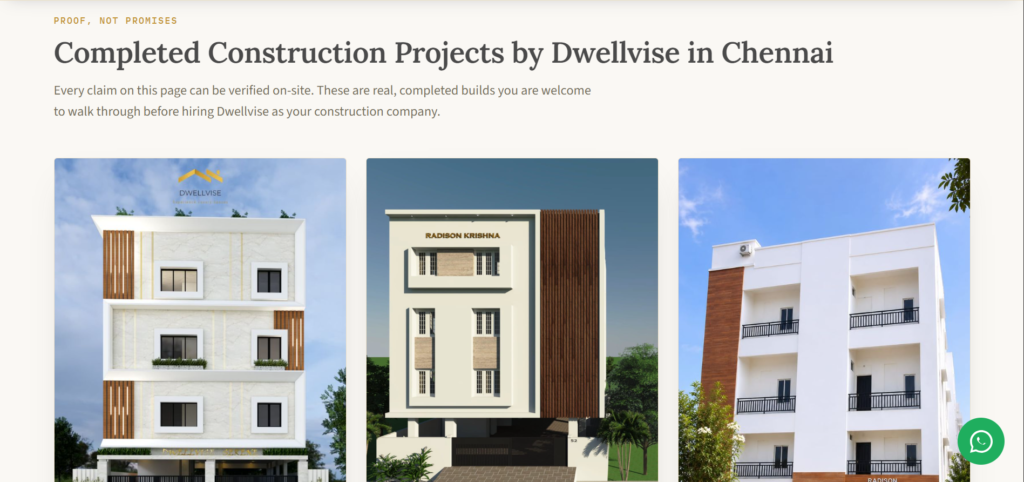
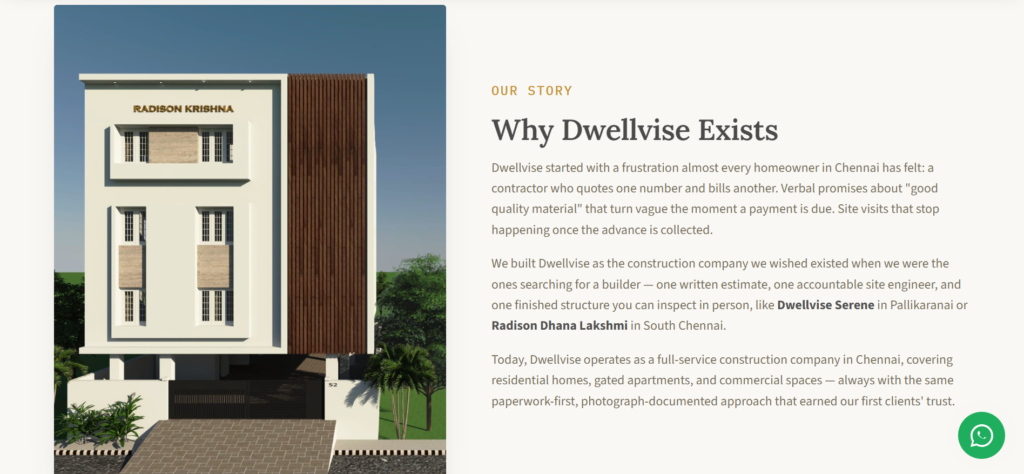
Ask how many independent houses (not just apartments) they have completed in the last 3–5 years, and ask to visit at least one ongoing site – not just a finished, photographed one. A site visit tells you more about quality of work, safety practices, and site discipline than any photograph. You can browse our completed and ongoing projects here (link to your real, verifiable portfolio page).
Materials & Quality Standards
Ask which brand and grade of steel (e.g., Fe 500/Fe 500D TMT bars), cement grade, and brick/block type they use as standard, and whether these meet Bureau of Indian Standards (BIS) specifications. A credible company will state this clearly in the agreement, not just verbally.
Transparent Costing & Payment Structure
A trustworthy builder gives a detailed cost breakup (structure, finishing, electrical, plumbing, etc.) rather than a single lump-sum figure with no explanation. Payments should be linked to construction milestones (foundation, roof-slab, brickwork, finishing) – never a large upfront payment before work begins.
Warranty & After-Service
Ask specifically: What is covered under warranty (structural, waterproofing, electrical)? For how long? Get this in writing in the agreement, not as a verbal promise.
4. Construction Cost Factors in Chennai (2026)
There is no single “correct” cost per square foot – it depends heavily on specification level, location, soil condition, and design complexity. Rather than quoting a fixed number (which changes with material prices and varies project to project), here are the factors that actually move your budget:
- Soil condition and foundation type – coastal and low-lying areas (parts of OMR, ECR, Velachery) often need deeper or reinforced foundations than areas with firmer soil.
- Specification level – basic, standard, or premium finishes (flooring, sanitaryware, electrical fittings) can shift the total cost by 20–35%.
- Design complexity – curved walls, double-height ceilings, and large cantilevers increase both material and labour cost.
- Structure type – load-bearing vs. RCC-framed structure changes both cost and construction time.
- Number of floors and setback requirements – determined by GCC/CMDA norms based on plot size and road width.
Practical tip: Ask any shortlisted company for a detailed, itemized quotation for your specific plot and specification – not a generic “per sq ft” number from their website. Compare quotations only after equalizing specifications (same brand of steel, same flooring grade, etc.); otherwise you’re not comparing like with like. For a deeper breakdown of pricing factors, see our House Construction Cost Guide.
5. Step-by-Step Process a Good Construction Company Follows
- Site visit and soil investigation – before any design work begins.
- Architectural design and structural drawing – including steel and concrete detailing by a qualified structural engineer.
- Plan approval – submission to Greater Chennai Corporation or CMDA/DTCP as applicable.
- Cost estimation and agreement – detailed, itemized, milestone-based.
- Foundation and structural work – footing, columns, beams, roof slab.
- Brickwork and plastering.
- Electrical and plumbing rough-in, followed by finishing (flooring, painting, fittings).
- Quality checks and handover, including a completion certificate where applicable.
A company that skips step 1 (soil investigation) or step 3 (approval) to “save time” is taking a shortcut that can cost you far more later – including legal risk.
6. Red Flags to Avoid When Choosing a Builder
- Refuses to put the cost breakup or material brands in writing.
- Demands a large payment (40–50%+) before any visible work starts.
- Cannot show you a currently ongoing site, only finished/photographed ones.
- Vague or evasive answers about who the structural engineer is.
- No mention of approvals, or claims that approval “isn’t needed” for your plot – this is rarely true and should be independently verified with GCC/CMDA.
- Pressure tactics (“this price is only valid today”) – genuine construction pricing doesn’t work like a retail sale.
7. Turnkey vs. Contract Construction – Comparison
| Factor | Turnkey Construction | Contract (Labour + Material Split) |
|---|---|---|
| Accountability | Single point of contact for design, materials, labour | Shared between you, contractor, and material suppliers |
| Cost predictability | Fixed price, fewer surprises | Variable – depends on your material buying decisions |
| Time involvement from you | Low – you review milestones | High – you’re actively sourcing and coordinating |
| Best suited for | Homeowners who want a hands-off experience | Homeowners who want to control material choices closely and have time to supervise |
| Typical cost | Slightly higher per sq ft | Can be lower, but risk of cost overrun is higher without tight supervision |
8. Documents & Approvals You Should Verify
Before signing any agreement, verify these exist or will be obtained:
- Approved building plan (Greater Chennai Corporation or CMDA/DTCP, depending on jurisdiction)
- Patta and land ownership documents
- Encumbrance Certificate (EC)
- Soil investigation report
- Structural stability certificate (for the design, from a licensed structural engineer)
- Detailed construction agreement with payment schedule and specifications
- Completion certificate (upon project completion, where applicable)
If the company you’re evaluating hesitates or cannot clearly explain any of these, treat it as a serious red flag. For construction specification references, authorities also refer to CPWD specifications and, for electrical connection norms, TANGEDCO.
9. Questions to Ask Any Construction Company Before Signing
Asking these questions directly is often the fastest way to tell whether a company is truly the best construction company in Chennai for your needs, or simply confident in its sales pitch:
- Can I see one of your currently ongoing sites?
- Who is your structural engineer, and can I see their credentials?
- What brand/grade of steel and cement do you use as standard?
- What exactly is included and excluded in the quoted price?
- What is the payment schedule, and is it linked to construction milestones?
- What happens if there’s a delay – is there a penalty clause?
- What warranty do you offer, and what does it cover?
- Will you handle the plan approval, or is that my responsibility?
10. Checklist: How to Shortlist a Construction Company
- Verified they secure/handle CMDA or GCC approval as applicable
- Visited at least one live/ongoing site (not just photos)
- Received a detailed, itemized cost quotation in writing
- Confirmed material brands and BIS compliance in writing
- Reviewed the payment milestone structure
- Clarified warranty terms in writing
- Spoken to at least one past client independently (not just testimonials on their website)
- Compared at least 2–3 companies on equal specifications before deciding
11. FAQs
Q: How do I find the best construction company in Chennai for my project? Check that the company can produce an approved building plan process, show you a live site, and give you a written, itemized quotation. The best construction company in Chennai for your needs is the one that’s transparent about all of these without hesitation – not necessarily the one with the biggest advertising budget.
Q: Is CMDA or Corporation approval really mandatory for an independent house in Chennai? Yes – construction without the appropriate approval (Greater Chennai Corporation within city limits, or CMDA/DTCP in areas under its jurisdiction) carries legal and financial risk, including potential penalties or demolition notices. Always verify jurisdiction and approval requirements for your specific plot with the relevant authority.
Q: What’s the difference between a contractor and a construction company? A contractor typically provides labour (and sometimes materials) for a defined scope, often under your or an architect’s supervision. A construction company usually offers an end-to-end service – design, approval coordination, materials, labour, and finishing – under one agreement.
Q: How long does house construction take in Chennai? Timelines vary significantly with size, design complexity, approval timelines, and monsoon disruptions. Ask any shortlisted company for a realistic, milestone-based schedule specific to your project rather than relying on a generic timeframe.
Q: Should I choose the lowest quotation? Not automatically. Compare quotations only after equalizing specifications (same steel grade, cement grade, flooring, fittings). A lower quote with lower-grade materials or vague inclusions often costs more in the long run through repairs or disputes.
12. Conclusion
There is no shortcut to finding the best construction company in Chennai – but there is a reliable process: verify approvals, insist on written and itemized costing, visit live sites, and ask direct questions about materials and structural design. A builder who welcomes this scrutiny is signaling confidence in their own work; one who resists it is telling you something too.
If you’re currently evaluating builders for your project in Chennai, use the checklist above as your working document – take it with you to every site visit and every quotation discussion. It’s the single most effective way to separate a genuinely capable construction company from one that simply markets well.
Planning your home construction in Chennai? Get in touch with Dwellvise for a detailed, no-obligation project consultation – we’re happy to walk through your requirements, plot specifics, and a transparent cost breakup with you.
