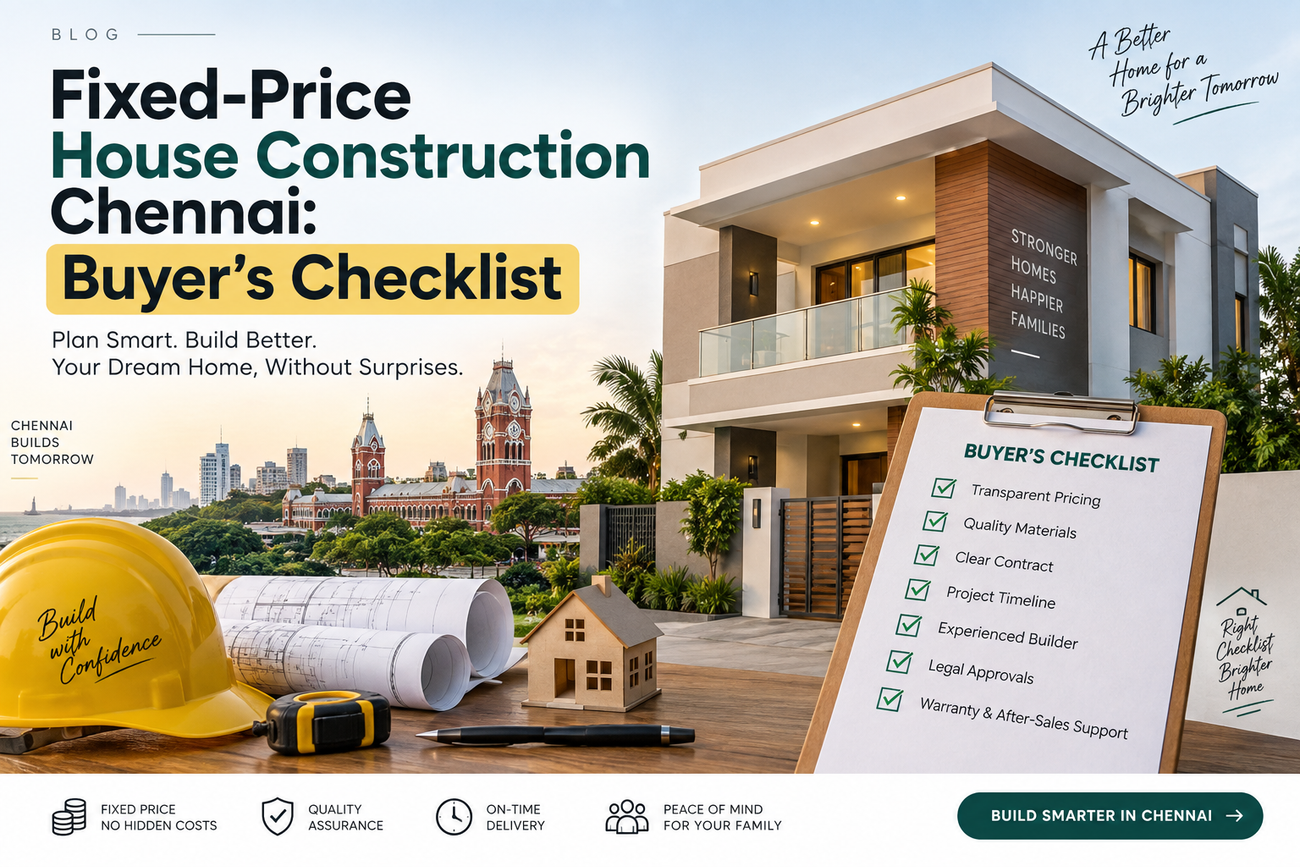
Most house construction disputes in Chennai don’t start on day one. They start around month four, when a “fixed” quote suddenly grows new line items – cement escalation, “additional” RCC work, a steel price adjustment nobody explained. By the time the family notices, the foundation is already poured. Switching builders isn’t realistic anymore.
Fixed-price house construction in Chennai should prevent this problem. But builders use the term loosely. Two quotes can both say “fixed price” and mean very different things. One means a complete, itemised, brand-specific cost sheet that doesn’t move. The other means a low headline number designed to win the contract, with the real cost revealed in instalments.
This guide explains what a genuine fixed-price contract should include, where the loopholes usually sit, and ten things to check before you sign anything.
What “Fixed-Price” Actually Means
A true fixed-price construction contract locks in the total cost for a defined scope before construction begins. It isn’t an estimate that gets “adjusted” later. For the fixed number to mean anything, it needs specifics attached to it:
- The exact built-up area and floor count
- The material brands and grades for cement, steel, blocks, plumbing and electrical fittings
- The structural specification — foundation type, RCC grade, number of RCC pours
- What “finishing” includes: flooring, painting, doors, windows, fixtures
- What’s explicitly excluded, and who covers those items
This differs from a cost-plus or rate contract, where you pay for the actual material and labour used, plus a margin. That model can end up cheaper or costlier than the original estimate, and it gives the builder less reason to control spend. It also differs from a vague verbal “package price” with no brand-specific cost sheet behind it – the most common source of Chennai construction disputes.
Why More Chennai Homeowners Want Fixed-Price Contracts
A few local factors push Chennai buyers toward fixed pricing:
- Long build timelines. A typical G+2 residential build takes 8–12 months. Steel and cement prices can shift meaningfully in that window. A fixed contract puts that risk on the builder, not you.
- Variable soil conditions. Bearing capacity differs block to block across Pallikaranai, Medavakkam, OMR and Velachery. This affects foundation depth and cost, so a fixed price should follow soil testing — not precede it.
- Multi-storey builds carry more variables. G+3 and G+4 structures need additional RCC pours and higher steel tonnage priced in from the start, not billed as “extras.”
- Budget certainty for a one-time spend. For most families, this is their largest single expense. A fixed, written number makes loan planning realistic.
- Coordination risk. When design, structural engineering and execution sit with separate parties, cost overruns are hard to trace to one source. A single fixed-price agreement keeps accountability in one place.
A fixed-price contract doesn’t guarantee a lower price. A properly costed one can come in higher than a suspiciously cheap estimate. What it buys is predictability.
Top 10 Things to Check Before Signing a Fixed-Price House Construction Contract in Chennai
1. Does the Quote Follow a Soil Test and Structural Drawing?
A fixed price issued before a site visit and soil test isn’t really fixed. It’s a placeholder that gets “corrected” once the ground conditions are known. Ask to see the soil report and structural drawing behind the quote before you sign.
2. Are Material Brands and Grades Named?
“Standard quality cement” and “ISI-marked steel” aren’t specifications. They’re phrases that leave room to swap in cheaper material later. A real fixed-price sheet names the cement grade, the steel grade, and the approved-brand list for tiles, sanitaryware, wiring and paint. The Bureau of Indian Standards publishes the National Building Code of India and the specific IS standards that material grades should reference — ask your builder which standards their cost sheet cites.
3. Does the Contract List Inclusions and Exclusions?
Compound wall, borewell, overhead tank, electrical connection charges and interior furniture are commonly excluded from a base construction contract. This isn’t always disclosed upfront. Get an explicit inclusions/exclusions list. Don’t accept a general phrase like “complete house construction.”
4. Is There a Written Payment Milestone Schedule?
Payments tied to completed, verifiable stages protect both sides better than payments tied to calendar dates. Confirm the schedule in writing. Check that no single milestone asks for a disproportionate advance relative to the work actually completed.
5. What Happens If Site Conditions Differ From the Soil Report?
Genuine unforeseen conditions – unexpected rock, a much higher water table – can legitimately affect cost even under a fixed price. What matters is whether the contract defines this narrowly, with a documented process, rather than leaving it as an open-ended escalation clause.
6. Is There a Penalty Clause for Delays?
A fixed price with no fixed timeline isn’t much of a guarantee. Check whether the contract names a start date, an estimated completion date, and a financial consequence if the builder misses it without a documented reason.
7. Who Handles Approvals, and Is That Cost Included?
Plan approval and documentation charges can be bundled into the fixed price or billed separately – both are fine. What isn’t fine is discovering the split only after you’ve paid the advance. Depending on your plot, approvals route through the Chennai Metropolitan Development Authority or the Greater Chennai Corporation; confirm which applies to your site and whether the builder is coordinating that filing.
8. How Are Design Changes Priced?
Almost every homeowner adjusts something mid-build – an extra window, a layout change. Ask how the contract prices variations. Is there a pre-agreed rate card for common changes, or does every change trigger an undefined negotiation?
9. Is Quality Verification Built Into the Process?
A fixed price only protects you if the specified quality gets delivered. Ask whether the contractor documents stage-wise quality checks – cube testing for concrete, mill test certificates for steel – and shares that documentation as the build progresses, not only at handover.
[IMAGE: fixed-price-house-construction-chennai-material-quality-check.jpg – Alt: “Site engineer checking steel and cement quality on a fixed-price house construction site in Chennai”]
10. What Does the Contract Say About Handover and Warranty?
Confirm what “complete” handover includes: snag-list closure, a workmanship warranty period, and the documents you’re entitled to – approved plan copies, material certificates, as-built drawings. A fixed price that ends abruptly at possession, with no post-handover accountability, is an incomplete agreement.
Fixed-Price vs Cost-Plus Construction in Chennai
Neither model wins outright. The right choice depends on how much budget certainty you want versus how much flexibility you need during the build.
| Factor | Fixed-Price Contract | Cost-Plus / Rate Contract |
|---|---|---|
| Budget predictability | High – total cost locked before work starts | Lower – final cost depends on actual usage and rates |
| Price escalation risk | Sits with the contractor | Sits largely with the homeowner |
| Flexibility for mid-project changes | Needs a pre-agreed variation process | Easier, but harder to track total cost |
| Transparency into material rates | Depends on the itemised sheet quality | Usually itemised by nature, needs regular audits |
| Best suited for | Homeowners who want one predictable number for loan planning | Owners who want to review every material choice and have time to manage it |
| Where disputes concentrate | Scope and exclusions at signing | Ongoing billing and rate verification |
What to Check on Site Before Building a House in Chennai
A few site-level factors affect both cost and durability. They should feed into any fixed-price quote you evaluate.
Ground and Drainage Conditions
Soil bearing capacity varies across South Chennai localities and directly affects foundation design and cost. Areas with a high water table also need waterproofing and foundation adjustments built into the fixed price from the start – not added later as a surprise line item.
Structural and Climate Factors
RCC grade, column spacing and reinforcement should be sized to your specific plot and floor count, not a generic template. Chennai’s heat and monsoon pattern also make orientation, cross-ventilation and roof insulation worth discussing at the design stage, before the structure goes up. Confirm electrical fittings are sized to actual load calculations and plumbing materials are climate-rated, rather than assumed as generic minimums.
How Dwellvise Approaches Fixed-Price, Transparent Construction
Dwellvise issues a written, itemised estimate after a site visit and soil assessment – not before. Every material brand gets specified in writing before work begins. The company follows a four-stage process for its residential construction services: consultation and site survey, drawing and approval and costing, construction with documented quality checks, and final handover with a signed workmanship warranty.
Dwellvise’s turnkey construction packages bundle civil work, electrical, plumbing and finishing under a single agreement – one common way homeowners get closer to true fixed pricing, with one accountable party instead of separate trades and separate invoices. The company’s completed construction projects, including Dwellvise Serene in Pallikaranai and Radison Dhana Lakshmi in South Chennai, are open for prospective clients to walk through before deciding.
This describes Dwellvise’s published process. It isn’t a guarantee for every project. Confirm the specific inclusions, exclusions and payment schedule in writing for your own plot before signing anything.
Frequently Asked Questions
What does “fixed-price house construction” actually mean? The total construction cost is agreed and documented in writing before work begins, tied to a specific scope, material brands and built-up area — not an estimate that gets revised as the project moves along.
Is fixed-price construction always cheaper than cost-plus? Not necessarily. A fixed-price contract trades some flexibility for budget certainty. The total can end up higher or lower than a cost-plus approach, depending on how carefully both are priced and managed.
How much does house construction cost per square foot in Chennai? Costs vary by specification and builder. Always confirm current numbers with a written, itemised quote for your specific plot rather than relying on a general range.
Can a fixed-price contract still have hidden costs? Yes, if the contract doesn’t explicitly list inclusions and exclusions. Compound walls, borewells and utility connection charges are common items left out of a “fixed” headline number unless stated otherwise.
What should a fixed-price construction agreement include? At minimum: built-up area, material brands and grades, a payment milestone schedule, a start and completion timeline, a documented process for design changes, and warranty terms.
Does a fixed-price contract cover plan approvals? It depends on the builder. Some bundle approval coordination into the fixed price; others bill it separately. Confirm which applies before signing.
How do I compare two fixed-price quotes that look very different? Compare the underlying specifications line by line — material grades, inclusions and exclusions, payment terms — rather than comparing only the final number. A lower headline price with vaguer specifications isn’t automatically the better deal.
What happens if actual costs exceed the fixed price? In a properly structured contract, that risk sits with the contractor, except for narrowly defined circumstances like genuinely unforeseen site conditions, which the agreement should spell out.
Before You Sign
A fixed price is only as reliable as the paperwork behind it. Get the soil report, the itemised material specification, the payment schedule and the timeline in writing before you commit to any Chennai construction agreement. Read all four together, not just the final number. If you’re planning a new home, villa, apartment or renovation project, compare this level of detail across a few builders before deciding. Reach out to Dwellvise directly for a written, site-specific cost estimate.
